By Major we understand something relatively great or bigger in size & by minor we understand some thing comparatively smaller in size or dimension. Scale means a unit of measurement. Major scale is an arrangement of notes in a particular ascending ( increasing ) order with certain value of frequency for each note. Similarly Minor scale is an arrangement of notes in a particular order with the increase oder of frequencies just like the major scale but with an exception that for some specific notes the frequencies are lesser as compared to their position in a Major scale. This I have explained in the video below. Please feel free to comment because its through discussion only we know the things.

Showing posts with label chromatic mouth organ. Show all posts
Showing posts with label chromatic mouth organ. Show all posts
Wednesday, October 19, 2011


Monday, October 10, 2011
BAHARON PHOOL BARSAO IN ' A minor & C - MAJOR '
Please listen to the harmonica renditions of the above song in both A minor & C minor scales played by me with the help of my Suzuki Chromatic harmonica model SCX - 64. As all of us know that SCX 64 of Suzuki, Super 64 & super 64 X of Hohner come in the key of C only. In the videos I have explained where to take the key note for C major & A minor with the same harmonica.
Monday, October 3, 2011
SHARPS, FLATS & FREQUENCY
In Music, so many times we come across the terms SHARP & FLAT. Some one says the note is F SHARP & some one says the scale is A FLAT etc. By practice we just accept & say C SHARP, E FLAT, F SHARP & A FLAT like that. Often during the rehearsals we hear that the guitarist adjusting the strings & listening to the pitch of the singer screams out the scale is B FLAT. Now let us understand what are these SHARPS & FLATS. By practice we identify a note as F# but why dont we say G FLAT for this when both are true because when the note F ascends it becomes F# or when the note G descends it becomes G FLAT. Finally F# & G FLAT are the same.
By the word SHARP we mean something ' pointed ' or ' piercing'. Imagine we are at the base of a steep mountain. Standing at the ground level we observe the tip of this cliff & we say its pointed or its sharp. It means we are at the base & our point of concentration is the highest level being our point of observation. It means by making a travel from base & proceding forward/ higher we acheive the highest point which we have confirmed as SHARP. Putting the same logic in music when we take a NOTE of a particular frequency & give an increment to its frequency we arrive at a particular frequency where the note gets SHARPENED, at that instant we say that the second note is the SHARP of the first one. The reverse order is also true. Thats,when we start decresing the frequency of the note we get the lower frequency where we say the Note is FLAT of the first one. Therefore SHARP & FLAT are inter related.
We conclude that the increase in frequency of a note to a particular value is the SHARP of that note & the decrease in frequency of a note to a praticular value is the FLAT of that note.
For example when note F steepens it becomes F# & when the same note F# widens that becomes note F.
Now coming to the word FREQUENCY & what does it mean in actual. The word frequency is dervied from the word 'Frequent' which means OCCURING OF AN ACTIVITY DURING A PARTICULAR TIME WITH AN INTERVAL. When the time interval , which we say GAP as a lay man , is more than the occurence , we say its less frequent & Vice versa. In music, frequency means the vibration of sound waves & the time interval is considered as one second. Therefore the frequency of a particular musical note is the vibration of its sound waves per second. Internationally the frequency of the note A is taken as the reference & all the rest of the notes have been designated with respect to this A note. The frequency of vibration of sound waves for this note A has the value 440 Cycles per second. According to the name of the scientist of its discovery the unit of frequency is also known as HERTZ & in short written as HZ.. Note A has the frequency of 440 HZ. This A belongs to the fifth octave & denoted as A4. About the OCTAVES it will be explained in the future posts. This note A has been taken as the reference because in olden days A was taken as the start with the notes of the scale as A,B,C,D,E,F,G & A of the next octave. You can observe in a key board all these notes are the white keys. Gradually due to the advent of the Major & minor scales this notes pattern of A scale became the A minor scale. This A was replaced by the note C as the threshold creating the C scale with the notes as C,D,E,F,G,A,B & C of the higher octave in the ascending order of the scale. This C scale has all the white notes on a key board making it the C Major scale with all the notes being the natural ones.
As regards the concept of OCTAVES, MAJOR , MINOR SCALES & CIRCLE OF FIFTH etc we will discuss in the future posts.
By the word SHARP we mean something ' pointed ' or ' piercing'. Imagine we are at the base of a steep mountain. Standing at the ground level we observe the tip of this cliff & we say its pointed or its sharp. It means we are at the base & our point of concentration is the highest level being our point of observation. It means by making a travel from base & proceding forward/ higher we acheive the highest point which we have confirmed as SHARP. Putting the same logic in music when we take a NOTE of a particular frequency & give an increment to its frequency we arrive at a particular frequency where the note gets SHARPENED, at that instant we say that the second note is the SHARP of the first one. The reverse order is also true. Thats,when we start decresing the frequency of the note we get the lower frequency where we say the Note is FLAT of the first one. Therefore SHARP & FLAT are inter related.
We conclude that the increase in frequency of a note to a particular value is the SHARP of that note & the decrease in frequency of a note to a praticular value is the FLAT of that note.
For example when note F steepens it becomes F# & when the same note F# widens that becomes note F.
Now coming to the word FREQUENCY & what does it mean in actual. The word frequency is dervied from the word 'Frequent' which means OCCURING OF AN ACTIVITY DURING A PARTICULAR TIME WITH AN INTERVAL. When the time interval , which we say GAP as a lay man , is more than the occurence , we say its less frequent & Vice versa. In music, frequency means the vibration of sound waves & the time interval is considered as one second. Therefore the frequency of a particular musical note is the vibration of its sound waves per second. Internationally the frequency of the note A is taken as the reference & all the rest of the notes have been designated with respect to this A note. The frequency of vibration of sound waves for this note A has the value 440 Cycles per second. According to the name of the scientist of its discovery the unit of frequency is also known as HERTZ & in short written as HZ.. Note A has the frequency of 440 HZ. This A belongs to the fifth octave & denoted as A4. About the OCTAVES it will be explained in the future posts. This note A has been taken as the reference because in olden days A was taken as the start with the notes of the scale as A,B,C,D,E,F,G & A of the next octave. You can observe in a key board all these notes are the white keys. Gradually due to the advent of the Major & minor scales this notes pattern of A scale became the A minor scale. This A was replaced by the note C as the threshold creating the C scale with the notes as C,D,E,F,G,A,B & C of the higher octave in the ascending order of the scale. This C scale has all the white notes on a key board making it the C Major scale with all the notes being the natural ones.
As regards the concept of OCTAVES, MAJOR , MINOR SCALES & CIRCLE OF FIFTH etc we will discuss in the future posts.
Friday, September 30, 2011
BAHARON PHOOL BARSAO - SARGAM
I am herewith giving the notations of the song in SARGAM. Please note that these are the notations when you play a C chromatic harmonica creating the scale of A minor. Please dont get confused that the note ' GA ' is not the komal ' ga ' of the base raag Shivranjani. With these notations note ' C ' becomes the ' ga ' of scale A minor. Therefore ' GA ' here, is the ' PA' of A scale.Please note that this ' PA ' position remains unchanged irrespective of the scale being a Major or a minor.
Some friends have requested for the hole numbers, since the notation pattern is still to be learnt by them. Our next posting of the same song identifying the hole numbers for practising this song.
BAHARON PHOOL BARSAO = GAGA MA DHA DHANISA... .SA..SASANISA
MERA MEHEBOOB AYA HAI = SASASASA NI- DHA-MAMADHANI-NI
MERA MEHEBOOB AYA HAI = NI - NIDHA DHANISA-SA-NISANI - DHA - DHA
HAWAON RAGNI GAO = GAGA MA DHA DHANISA... .SA..SASANISA
MERA MEHEBOOB AYA HAI =SASASASA NI- DHA-MAMADHANI-NI
MERA MEHEBOOB AYA HAI =NI - NIDHA DHANIre - re -NISANI-DHA - DHA
****************************************************************************
O LAALEE PHOOL KI MEHENDI = GA'GA'MA'SA' - SA'- SA'GA'GA'MA'SA' - SA'
LAGAA IN GORE HATHONMEIN =SANISADHA - DHA MA SADHASADHASA-SA
UTAR AA EI GHATAA KAAJAL = GA'GA'MA'SA' - SA' - SA'GA'GA'MA'SA' - SA'
LAGAA IN PYARI AANKHONMEIN = SANISADHA - DHA MA SADHASADHASA - SA
SITARON MAANG BHAR JAO = GAGA MA DHA DHANISA - SA - SASANISA
MERA MEHEBOOB AYA HAI = SASASASA NI - DHA - MAMADHANI - NI
MERA MEHEBOOB AYA HAI = NI - NIDHADHANIre - re - NISANI - DHA - DHA
Some friends have requested for the hole numbers, since the notation pattern is still to be learnt by them. Our next posting of the same song identifying the hole numbers for practising this song.
BAHARON PHOOL BARSAO = GAGA MA DHA DHANISA... .SA..SASANISA
MERA MEHEBOOB AYA HAI = SASASASA NI- DHA-MAMADHANI-NI
MERA MEHEBOOB AYA HAI = NI - NIDHA DHANISA-SA-NISANI - DHA - DHA
HAWAON RAGNI GAO = GAGA MA DHA DHANISA... .SA..SASANISA
MERA MEHEBOOB AYA HAI =SASASASA NI- DHA-MAMADHANI-NI
MERA MEHEBOOB AYA HAI =NI - NIDHA DHANIre - re -NISANI-DHA - DHA
****************************************************************************
O LAALEE PHOOL KI MEHENDI = GA'GA'MA'SA' - SA'- SA'GA'GA'MA'SA' - SA'
LAGAA IN GORE HATHONMEIN =SANISADHA - DHA MA SADHASADHASA-SA
UTAR AA EI GHATAA KAAJAL = GA'GA'MA'SA' - SA' - SA'GA'GA'MA'SA' - SA'
LAGAA IN PYARI AANKHONMEIN = SANISADHA - DHA MA SADHASADHASA - SA
SITARON MAANG BHAR JAO = GAGA MA DHA DHANISA - SA - SASANISA
MERA MEHEBOOB AYA HAI = SASASASA NI - DHA - MAMADHANI - NI
MERA MEHEBOOB AYA HAI = NI - NIDHADHANIre - re - NISANI - DHA - DHA
Friday, September 23, 2011
CROWDING OF NOTES
While writing the notes I have carefully adjusted the gaps & checked in the draft also. I found it to be in order, but after its published I was surprised to see them all getting crowded making very difficult to understand. I am again arranging in a phrased manner so that there wont be any confusion in understanding. I regret the inconvenience caused. As all of us have the conventional Chromatic harmonica in the scale of C you can play this song as per the notes. By doing so you will be playing this song in the scale of A minor in this C scale harmonica. Here you are taking the start ( Key note ) as E. To play this song in the scale of C minor in the same harmonica you have to take the start ( Key note ) as G which is 3 semitones ahead of E.
BAHARON PHOOL BARSAO = EEF#A ABC-C-CCBC
MERA MEHEBOOB AYA HAI = CCCC B-A-F# F#AB-B
MERA MEHEBOOB AYA HAI = B-BA ABC-C BCB-A-A
HAWAON RAGNI GAO = EEF#A ABC-C-CCBC
MERA MEHEBOOB AYA HAI =CCCC B-A-F# F#AB-B
MERA MEHEBOOB AYA HAI = B-BA ABC#-C# BCB-A-A
****************************************************************************
O LAALEE PHOOL KI MEHENDI = E'E'F#'C'-C' E'E'F#'C'-C'
LAGAA IN GORE HATHONMEIN =CBCA-AF#CBCBA-A
UTAR AA EI GHATAA KAAJAL = E'-E'E'F#'C'-C' E'E'F#'C'-C'
LAGAA IN PYARI AANKHONMEIN = CBCA-AF#CBCBA-A
SITARON MAANG BHAR JAO = EEF#A ABC-C CCBC
MERA MEHEBOOB AYA HAI = CCCC B-A-F# F#AB-B
MERA MEHEBOOB AYA HAI = B-BA ABC#C# BCB-A-A
These are the basic notes. we can add flavour to it by vibrato or putting some accidental notes. please operate the slider gently either with your fore finger or the thumb. Please dont hit it with your palm since its very delicate.
We are open for any corrections and suggestions since we learn though our mistakes & errors.
BAHARON PHOOL BARSAO = EEF#A ABC-C-CCBC
MERA MEHEBOOB AYA HAI = CCCC B-A-F# F#AB-B
MERA MEHEBOOB AYA HAI = B-BA ABC-C BCB-A-A
HAWAON RAGNI GAO = EEF#A ABC-C-CCBC
MERA MEHEBOOB AYA HAI =CCCC B-A-F# F#AB-B
MERA MEHEBOOB AYA HAI = B-BA ABC#-C# BCB-A-A
****************************************************************************
O LAALEE PHOOL KI MEHENDI = E'E'F#'C'-C' E'E'F#'C'-C'
LAGAA IN GORE HATHONMEIN =CBCA-AF#CBCBA-A
UTAR AA EI GHATAA KAAJAL = E'-E'E'F#'C'-C' E'E'F#'C'-C'
LAGAA IN PYARI AANKHONMEIN = CBCA-AF#CBCBA-A
SITARON MAANG BHAR JAO = EEF#A ABC-C CCBC
MERA MEHEBOOB AYA HAI = CCCC B-A-F# F#AB-B
MERA MEHEBOOB AYA HAI = B-BA ABC#C# BCB-A-A
These are the basic notes. we can add flavour to it by vibrato or putting some accidental notes. please operate the slider gently either with your fore finger or the thumb. Please dont hit it with your palm since its very delicate.
We are open for any corrections and suggestions since we learn though our mistakes & errors.
Thursday, January 21, 2010
My grandson's toy
My five-month-old grandson, Maitreya, loves to listen to music, specially that produced by mouth organ. He invariably stops crying whenever I start playing mouth organ. In fact, this gives me an excuse to play mouth organ, defying the scornful look of my wife who has suffered my music for over 35 years.

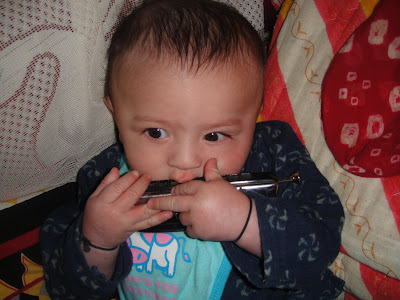

I gave my 'Puck' and 'Chrometta 10' to Maitreya to play with. To my pleasant surprise, he held the harmonica just the way I hold it while playing.
Subscribe to:
Posts (Atom)