Shivang Shastri is 13 year old and he played `pavane`by Faure at NHL Bristol 2011
Shivang's family is from Ahmedabad. His grandfather was in GEB Ahmedabad
His father is a Doctor living in Brmingham.
http://www.youtube.com/watch?v=yR-ZomuQRug

Showing posts with label chromatic harmonica. Show all posts
Showing posts with label chromatic harmonica. Show all posts
Thursday, November 10, 2011


Saturday, October 29, 2011
Apoorva Bhatt weaves music
The Harmonica Club of Gujarat has some gems without who this tiny musical instrument would not have gained popularity among the generation next. One such gem is textiles engineer from Baroda, Apoorva Bhatt. He has taught scores of young people the art and craft of playing mouth organ. A perfectionist, Apoorva rehearses several times over before his public performance. However, his friends and fans have captured on video several of his renditions off guard. Here are some samples.
1. Jyoti Kalash Chhalake
2. Dil Ek Mandir Hai
Sunday, October 23, 2011
Sagar Kinare by Sirish Swami
Literally from across seven seas, Sirish Swami has brought to us this wonderful rendition of the song Sagar Kinare from the film Sagar.
Wednesday, October 19, 2011
MINOR SCALES IN MUSIC
The Minor scales have been classified mainly into three categories. They are Natural Minor, Melodic Minor & the Harmonic Minor.
Natural Minor three notes get flattened & they are E, A & B. For the scale C natural Minor we can write the scale structure as C,D,Eb,F,G,Ab,Bb & C.
For Harmonic minor two notes gets flattened & they are note E & note A. For the scale C Harmonic minor we can write it as C,D,Eb,F,G,Ab,B & C.
For Melodic Minor its a bit confusing to grasp. There is a clear difference in the ascending & descending order of the scale.
Ascending order is C,D,Eb, F,G,A,B & C
Descending order is C,D,Eb,F,G,Ab,Bb& C
This I have explained in the video attached here with.
Natural Minor three notes get flattened & they are E, A & B. For the scale C natural Minor we can write the scale structure as C,D,Eb,F,G,Ab,Bb & C.
For Harmonic minor two notes gets flattened & they are note E & note A. For the scale C Harmonic minor we can write it as C,D,Eb,F,G,Ab,B & C.
For Melodic Minor its a bit confusing to grasp. There is a clear difference in the ascending & descending order of the scale.
Ascending order is C,D,Eb, F,G,A,B & C
Descending order is C,D,Eb,F,G,Ab,Bb& C
This I have explained in the video attached here with.
Monday, October 10, 2011
BAHARON PHOOL BARSAO IN ' A minor & C - MAJOR '
Please listen to the harmonica renditions of the above song in both A minor & C minor scales played by me with the help of my Suzuki Chromatic harmonica model SCX - 64. As all of us know that SCX 64 of Suzuki, Super 64 & super 64 X of Hohner come in the key of C only. In the videos I have explained where to take the key note for C major & A minor with the same harmonica.
Monday, October 3, 2011
SHARPS, FLATS & FREQUENCY
In Music, so many times we come across the terms SHARP & FLAT. Some one says the note is F SHARP & some one says the scale is A FLAT etc. By practice we just accept & say C SHARP, E FLAT, F SHARP & A FLAT like that. Often during the rehearsals we hear that the guitarist adjusting the strings & listening to the pitch of the singer screams out the scale is B FLAT. Now let us understand what are these SHARPS & FLATS. By practice we identify a note as F# but why dont we say G FLAT for this when both are true because when the note F ascends it becomes F# or when the note G descends it becomes G FLAT. Finally F# & G FLAT are the same.
By the word SHARP we mean something ' pointed ' or ' piercing'. Imagine we are at the base of a steep mountain. Standing at the ground level we observe the tip of this cliff & we say its pointed or its sharp. It means we are at the base & our point of concentration is the highest level being our point of observation. It means by making a travel from base & proceding forward/ higher we acheive the highest point which we have confirmed as SHARP. Putting the same logic in music when we take a NOTE of a particular frequency & give an increment to its frequency we arrive at a particular frequency where the note gets SHARPENED, at that instant we say that the second note is the SHARP of the first one. The reverse order is also true. Thats,when we start decresing the frequency of the note we get the lower frequency where we say the Note is FLAT of the first one. Therefore SHARP & FLAT are inter related.
We conclude that the increase in frequency of a note to a particular value is the SHARP of that note & the decrease in frequency of a note to a praticular value is the FLAT of that note.
For example when note F steepens it becomes F# & when the same note F# widens that becomes note F.
Now coming to the word FREQUENCY & what does it mean in actual. The word frequency is dervied from the word 'Frequent' which means OCCURING OF AN ACTIVITY DURING A PARTICULAR TIME WITH AN INTERVAL. When the time interval , which we say GAP as a lay man , is more than the occurence , we say its less frequent & Vice versa. In music, frequency means the vibration of sound waves & the time interval is considered as one second. Therefore the frequency of a particular musical note is the vibration of its sound waves per second. Internationally the frequency of the note A is taken as the reference & all the rest of the notes have been designated with respect to this A note. The frequency of vibration of sound waves for this note A has the value 440 Cycles per second. According to the name of the scientist of its discovery the unit of frequency is also known as HERTZ & in short written as HZ.. Note A has the frequency of 440 HZ. This A belongs to the fifth octave & denoted as A4. About the OCTAVES it will be explained in the future posts. This note A has been taken as the reference because in olden days A was taken as the start with the notes of the scale as A,B,C,D,E,F,G & A of the next octave. You can observe in a key board all these notes are the white keys. Gradually due to the advent of the Major & minor scales this notes pattern of A scale became the A minor scale. This A was replaced by the note C as the threshold creating the C scale with the notes as C,D,E,F,G,A,B & C of the higher octave in the ascending order of the scale. This C scale has all the white notes on a key board making it the C Major scale with all the notes being the natural ones.
As regards the concept of OCTAVES, MAJOR , MINOR SCALES & CIRCLE OF FIFTH etc we will discuss in the future posts.
By the word SHARP we mean something ' pointed ' or ' piercing'. Imagine we are at the base of a steep mountain. Standing at the ground level we observe the tip of this cliff & we say its pointed or its sharp. It means we are at the base & our point of concentration is the highest level being our point of observation. It means by making a travel from base & proceding forward/ higher we acheive the highest point which we have confirmed as SHARP. Putting the same logic in music when we take a NOTE of a particular frequency & give an increment to its frequency we arrive at a particular frequency where the note gets SHARPENED, at that instant we say that the second note is the SHARP of the first one. The reverse order is also true. Thats,when we start decresing the frequency of the note we get the lower frequency where we say the Note is FLAT of the first one. Therefore SHARP & FLAT are inter related.
We conclude that the increase in frequency of a note to a particular value is the SHARP of that note & the decrease in frequency of a note to a praticular value is the FLAT of that note.
For example when note F steepens it becomes F# & when the same note F# widens that becomes note F.
Now coming to the word FREQUENCY & what does it mean in actual. The word frequency is dervied from the word 'Frequent' which means OCCURING OF AN ACTIVITY DURING A PARTICULAR TIME WITH AN INTERVAL. When the time interval , which we say GAP as a lay man , is more than the occurence , we say its less frequent & Vice versa. In music, frequency means the vibration of sound waves & the time interval is considered as one second. Therefore the frequency of a particular musical note is the vibration of its sound waves per second. Internationally the frequency of the note A is taken as the reference & all the rest of the notes have been designated with respect to this A note. The frequency of vibration of sound waves for this note A has the value 440 Cycles per second. According to the name of the scientist of its discovery the unit of frequency is also known as HERTZ & in short written as HZ.. Note A has the frequency of 440 HZ. This A belongs to the fifth octave & denoted as A4. About the OCTAVES it will be explained in the future posts. This note A has been taken as the reference because in olden days A was taken as the start with the notes of the scale as A,B,C,D,E,F,G & A of the next octave. You can observe in a key board all these notes are the white keys. Gradually due to the advent of the Major & minor scales this notes pattern of A scale became the A minor scale. This A was replaced by the note C as the threshold creating the C scale with the notes as C,D,E,F,G,A,B & C of the higher octave in the ascending order of the scale. This C scale has all the white notes on a key board making it the C Major scale with all the notes being the natural ones.
As regards the concept of OCTAVES, MAJOR , MINOR SCALES & CIRCLE OF FIFTH etc we will discuss in the future posts.
Friday, September 30, 2011
BAHARON PHOOL BARSAO - SARGAM
I am herewith giving the notations of the song in SARGAM. Please note that these are the notations when you play a C chromatic harmonica creating the scale of A minor. Please dont get confused that the note ' GA ' is not the komal ' ga ' of the base raag Shivranjani. With these notations note ' C ' becomes the ' ga ' of scale A minor. Therefore ' GA ' here, is the ' PA' of A scale.Please note that this ' PA ' position remains unchanged irrespective of the scale being a Major or a minor.
Some friends have requested for the hole numbers, since the notation pattern is still to be learnt by them. Our next posting of the same song identifying the hole numbers for practising this song.
BAHARON PHOOL BARSAO = GAGA MA DHA DHANISA... .SA..SASANISA
MERA MEHEBOOB AYA HAI = SASASASA NI- DHA-MAMADHANI-NI
MERA MEHEBOOB AYA HAI = NI - NIDHA DHANISA-SA-NISANI - DHA - DHA
HAWAON RAGNI GAO = GAGA MA DHA DHANISA... .SA..SASANISA
MERA MEHEBOOB AYA HAI =SASASASA NI- DHA-MAMADHANI-NI
MERA MEHEBOOB AYA HAI =NI - NIDHA DHANIre - re -NISANI-DHA - DHA
****************************************************************************
O LAALEE PHOOL KI MEHENDI = GA'GA'MA'SA' - SA'- SA'GA'GA'MA'SA' - SA'
LAGAA IN GORE HATHONMEIN =SANISADHA - DHA MA SADHASADHASA-SA
UTAR AA EI GHATAA KAAJAL = GA'GA'MA'SA' - SA' - SA'GA'GA'MA'SA' - SA'
LAGAA IN PYARI AANKHONMEIN = SANISADHA - DHA MA SADHASADHASA - SA
SITARON MAANG BHAR JAO = GAGA MA DHA DHANISA - SA - SASANISA
MERA MEHEBOOB AYA HAI = SASASASA NI - DHA - MAMADHANI - NI
MERA MEHEBOOB AYA HAI = NI - NIDHADHANIre - re - NISANI - DHA - DHA
Some friends have requested for the hole numbers, since the notation pattern is still to be learnt by them. Our next posting of the same song identifying the hole numbers for practising this song.
BAHARON PHOOL BARSAO = GAGA MA DHA DHANISA... .SA..SASANISA
MERA MEHEBOOB AYA HAI = SASASASA NI- DHA-MAMADHANI-NI
MERA MEHEBOOB AYA HAI = NI - NIDHA DHANISA-SA-NISANI - DHA - DHA
HAWAON RAGNI GAO = GAGA MA DHA DHANISA... .SA..SASANISA
MERA MEHEBOOB AYA HAI =SASASASA NI- DHA-MAMADHANI-NI
MERA MEHEBOOB AYA HAI =NI - NIDHA DHANIre - re -NISANI-DHA - DHA
****************************************************************************
O LAALEE PHOOL KI MEHENDI = GA'GA'MA'SA' - SA'- SA'GA'GA'MA'SA' - SA'
LAGAA IN GORE HATHONMEIN =SANISADHA - DHA MA SADHASADHASA-SA
UTAR AA EI GHATAA KAAJAL = GA'GA'MA'SA' - SA' - SA'GA'GA'MA'SA' - SA'
LAGAA IN PYARI AANKHONMEIN = SANISADHA - DHA MA SADHASADHASA - SA
SITARON MAANG BHAR JAO = GAGA MA DHA DHANISA - SA - SASANISA
MERA MEHEBOOB AYA HAI = SASASASA NI - DHA - MAMADHANI - NI
MERA MEHEBOOB AYA HAI = NI - NIDHADHANIre - re - NISANI - DHA - DHA
Monday, September 19, 2011
NOTES , TONES & SCALES
Before proceeding into the notations & songs I would like to share a bit of my knowledge about the Scales, Notes & Tones from concept point of view which is highly essential for the inset of Concept.
TONE means a sound of a certain frequency. Sometimes the tone is pleasant to the ear & some times it is pungent to the ear. The pungent one we term as NOISE and the pleasant ones we chose to put them in order making a garland of NOTES which is known as SCALE. We identify each note by a name depending upon their frequencies. Putting these set of notes in ascending order of their frequencies & making a chain is the SCALE. As each NOTE has a name, similarly each SCALE has a name. Conventionally the scale starts with C as the reference having the notes ascending order staring with the note name C.
There are 12 NOTES viz C , C# , D, D# ( Eb ) , E , F , F# , G , G# ( Ab ) , A , A# ( Bb ) & B .
similarly 12 SCALES with the same names as the NOTES. In a particular scale there are seven notes in total.
Example Scale ' C ' = C , D , E , F , G , A , B & again C of the next octave.
The Major & Minor concept of the SCALE , FLAT & SHARP NOTES I will explain latter.
I will upload the song BAHARON PHOOL BARSAO with the original song then the play of the same song in the original scale on harmonica.
Finally for the understanding & grasp of the song I will give the notations of the song.
TONE means a sound of a certain frequency. Sometimes the tone is pleasant to the ear & some times it is pungent to the ear. The pungent one we term as NOISE and the pleasant ones we chose to put them in order making a garland of NOTES which is known as SCALE. We identify each note by a name depending upon their frequencies. Putting these set of notes in ascending order of their frequencies & making a chain is the SCALE. As each NOTE has a name, similarly each SCALE has a name. Conventionally the scale starts with C as the reference having the notes ascending order staring with the note name C.
There are 12 NOTES viz C , C# , D, D# ( Eb ) , E , F , F# , G , G# ( Ab ) , A , A# ( Bb ) & B .
similarly 12 SCALES with the same names as the NOTES. In a particular scale there are seven notes in total.
Example Scale ' C ' = C , D , E , F , G , A , B & again C of the next octave.
The Major & Minor concept of the SCALE , FLAT & SHARP NOTES I will explain latter.
I will upload the song BAHARON PHOOL BARSAO with the original song then the play of the same song in the original scale on harmonica.
Finally for the understanding & grasp of the song I will give the notations of the song.
Wednesday, April 14, 2010
99% me Ghadi varna Chhadi
Master Kavit again, with 3 idiots in the background. He spent a very few minutes to get ready with this song.
Rishwat to khud Baap ne lena shikhaya, 99% marks laaoge to Ghadi varna Chhadi.......................... :-(
Friday, April 9, 2010
Saz aur Avaaz : Part 2
The other day, we had a guest Mr. Salim malik, also known as Voice of Mukesh. Businessman Mr. Malik used to sing in his college days, and thereafter due to very heavy business load, left singing for many years.
Satisfied with the achievement in business, he decided to develop his forgotten hobby again after almost 20 years. He started with a professional training under Mr. Bhuprndra and now is a well known singer again.
He is invited by many business and corporate houses, private meetings etc.
Aditya and Manohar Vaidya accompanied Malik on their harmonicas.
That was a Funday !!!!
Satisfied with the achievement in business, he decided to develop his forgotten hobby again after almost 20 years. He started with a professional training under Mr. Bhuprndra and now is a well known singer again.
He is invited by many business and corporate houses, private meetings etc.
Aditya and Manohar Vaidya accompanied Malik on their harmonicas.
That was a Funday !!!!
Thursday, January 21, 2010
My grandson's toy
My five-month-old grandson, Maitreya, loves to listen to music, specially that produced by mouth organ. He invariably stops crying whenever I start playing mouth organ. In fact, this gives me an excuse to play mouth organ, defying the scornful look of my wife who has suffered my music for over 35 years.

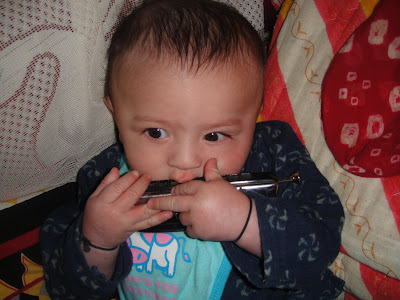

I gave my 'Puck' and 'Chrometta 10' to Maitreya to play with. To my pleasant surprise, he held the harmonica just the way I hold it while playing.
Wednesday, December 30, 2009
Generation Next Picks Up the Baton
When Harmonica Club of Gujarat was formed two years ago, all the six founding members were in their late 40s and 50s. They had seen the popularity of mouth organ in their youth. They had also seen the gradual decline of the use of this tiny musical instrument with the advent of electronic keyboard and digital music.
The founding members made a conscious decision to perform in public parks, unmindful of the ridicule they might face from the public at displaying their enthusiasm openly. They thought this was an effective way to communicate with the masses and enthuse the young people to take up playing harmonica.
They proved right. Soon enough, several parents approached the club members with the desire to make their children learn harmonica. Founder member Paresh Bhatia, a music teacher, came to their help. He started training school children. The result is here for all to see. Aditya and Devansh, not even in their teens, have become good mouth organ players in less than a year's time. While they received their initial training from Paresh Bhatia, they achieved finesse under the able guidance of the veteran guru Manohar Vaidya, who has been playing mouth organ for more than 50 years.
Here is a popular number 'Kisi Ki Muskuraahaton Pe Ho Nissar' played by Devansh and Aditya under the tutelage of the Guruji at the Kankaria Carnival in Ahmedabad on December 29, 2009.
Sunday, October 19, 2008
Monday, August 25, 2008
Sabnavees Spells Magic through Suzuki
We had introduced Ramakrishna Sabnavees on this blog sometime ago. An engineer by profession, Sabnavees had picked up mouth organ in his childhood. He is the founder of the Harmonica Club of Hyderabad. May his tribe grow. Here are some of his numbers:
AJEEB DAASTAN HAI YEH
ZARA HAULE HAULE CHALO
SRILANKAN MELODY
THIS IS A SRILANKAN MELODY WHICH I HEARD FROM MY SRILANKAN FRIEND WHEN I WAS WORKING IN MUSCAT
DIL DEKE DEKHO
JANE MANN JANE MANN
DIL TADAP TADAP KE
TUMSA NAHIN DEKHA
YEH RAAT PHIR NA AAYEGI
AJEEB DAASTAN HAI YEH
ZARA HAULE HAULE CHALO
SRILANKAN MELODY
THIS IS A SRILANKAN MELODY WHICH I HEARD FROM MY SRILANKAN FRIEND WHEN I WAS WORKING IN MUSCAT
DIL DEKE DEKHO
JANE MANN JANE MANN
DIL TADAP TADAP KE
TUMSA NAHIN DEKHA
YEH RAAT PHIR NA AAYEGI
Wednesday, August 13, 2008
Jare Udaja re Panchhi : Apoorva Bhatt
Apoorva Bhatt played this song in Kamati Baug, Vadodara.
He prefers to play 12 hole chromatic harmonica in scale C.
I remember my first meeting with Apoorva Bhatt, I had just started learning to play harmonica from Paresh Bhatia. One evening he told me that a harmonica group was invited in Ahmedabad and i must attend the show as he was to fly to Dubai.
I reached the venue one hour earlier with my collection of harmonicas.
I was introduced to all the players by Amjadbhai and then suddenly Apoorva Bhatt came to me looking at the collection softly asked ' very nice , now let us hear you play ', and i took out one tiny Marine Band Delux and started playing ' maine tere liye hi saat rang ke ' which i had recently learnt. The moment i finished the first stanza he stopped me and started playing the interlude music. That time I noticed two things, one he was playing some different instrument than mine and secondly his style of play.
I asked him to show his harmonica and that was 12 hole super chromonica 270.
I took the complete video of the programme as i was asked to sit in the first raw, and after the programme got over i went to him to get some tips. He gave me his visiting card and said ' come to Baroda for the whole day ' that's all....
Then after a couple of days he called me and asked if i could share the video of that programme with him, and also gave me a hint that Holi was after two days. And i was in Baroda on Holi.
we spent the whole day together with Amjadbhai, Rupesh and one little girl who plays Tadap Tadap song. I was trained to play Chords, Octave, Whamping etc. That day I had my first Chromatic harmonicas. I was given super chromonica 270 and 280.
I had mentioned this incidence in the yahoo group, thanking all the Baroda players.
Today not a single day goes without talking.
Only fortunate people get a friend like Apoorva Bhatt.
He prefers to play 12 hole chromatic harmonica in scale C.
I remember my first meeting with Apoorva Bhatt, I had just started learning to play harmonica from Paresh Bhatia. One evening he told me that a harmonica group was invited in Ahmedabad and i must attend the show as he was to fly to Dubai.
I reached the venue one hour earlier with my collection of harmonicas.
I was introduced to all the players by Amjadbhai and then suddenly Apoorva Bhatt came to me looking at the collection softly asked ' very nice , now let us hear you play ', and i took out one tiny Marine Band Delux and started playing ' maine tere liye hi saat rang ke ' which i had recently learnt. The moment i finished the first stanza he stopped me and started playing the interlude music. That time I noticed two things, one he was playing some different instrument than mine and secondly his style of play.
I asked him to show his harmonica and that was 12 hole super chromonica 270.
I took the complete video of the programme as i was asked to sit in the first raw, and after the programme got over i went to him to get some tips. He gave me his visiting card and said ' come to Baroda for the whole day ' that's all....
Then after a couple of days he called me and asked if i could share the video of that programme with him, and also gave me a hint that Holi was after two days. And i was in Baroda on Holi.
we spent the whole day together with Amjadbhai, Rupesh and one little girl who plays Tadap Tadap song. I was trained to play Chords, Octave, Whamping etc. That day I had my first Chromatic harmonicas. I was given super chromonica 270 and 280.
I had mentioned this incidence in the yahoo group, thanking all the Baroda players.
Today not a single day goes without talking.
Only fortunate people get a friend like Apoorva Bhatt.
Tuesday, August 5, 2008
Mouth organ/ Harmonicas for sale : Amjadbhai Pathan
Dear Harmonica lovers,
I have 100 pcs of Tower brand Chromatic Harmonicas for sale. Basic price is Rs 140 + freight.
Pl contact on 09327235096.
Amjad pathan
( Babubhai, Vadodara )
I have 100 pcs of Tower brand Chromatic Harmonicas for sale. Basic price is Rs 140 + freight.
Pl contact on 09327235096.
Amjad pathan
( Babubhai, Vadodara )
Subscribe to:
Posts (Atom)